The Ministerial Proclamation & Live Execution: Why the Crowd Froze in Awe
In October 2026, at the Gwanghwamun Square celebration marking the centennial eve of Hangul Day, the Minister of Culture, Sports and Tourism delivered a solemn commemorative address into the crisp autumn night air. Before a colossal blank white canvas stood a single master calligrapher holding a giant ink-laden brush.
In breathless silence, the brush sliced through the void. In mere moments, the regal portrait of King Sejong adorned in his iconic red royal robes materialized with ferocious precision. Seamlessly followed by sweeping strokes of bold calligraphy, a majestic masterpiece claimed the entire canvas. Thousands of spectators and international delegates erupted in spontaneous thunderous applause.
This moment presents a profound question to global convention leaders. Millions of dollars are routinely spent on sterile high-resolution LED walls and glossy 3D motion graphics, yet delegates forget them the second the hall doors shut. Conversely, the living stroke of brush and ink unfolding under the open night sky carved an unforgettable emotional and cultural anchor in every observer's memory. It proved that authentic, live cultural storytelling—not hardware square meters—is the definitive catalyst for human engagement.
- • Consonants and vowels arranged strictly left-to-right
- • Incapable of forming visual 2D syllable blocks
- • Unpredictable horizontal footprint based on word length
- • Inherently limited in self-contained typographic geometry
- • Initial, medial, and final components synthesize in square blocks
- • 24 basic letters generate 11,172 distinct syllable combinations
- • Geometric primitives (dot, line, circle) align directly with design
- • Highest spatial compression for mobile typing and AI LLM tokenization
The 3 Primitives (Heaven, Earth, Man) & 24 Letters: King Sejong’s 1443 Open-Source OS
Viewing Hunminjeongeum merely as the birth of an alphabet grasps only half of its genius. When analyzed through modern software engineering lenses, the writing system King Sejong created in 1443 and documented in the 1446 Hunminjeongeum Haeryebon was the most elegant and resilient open-source operating system in human history.
Sejong designed base consonants by imitating the physical geometry of speech organs (tongue, teeth, throat) and derived phonetic variations through systematic stroke addition. His vowel design was even more visionary: utilizing just 3 primitive tokens—a round dot for Heaven (·), a flat line for Earth (ㅡ), and an upright line for Man (ㅣ)—he synthesized every human vowel tone.
Most revolutionary is that these elements do not line up in a flat row. Instead, initial, vowel, and final consonants dynamically snap together inside a 2D square matrix block. Generating 11,172 distinct acoustic syllables from just 24 minimal components represents the exact 'component-based modular architecture' that modern cloud software architects aspire to build. It was the historical genesis of universal information democratization.
How Modular Snap-Together Architecture Breathed Hyper-Speed Storytelling into K-Content
Why has 21st-century Korean culture—spanning BTS, Squid Game, Bong Joon-ho films, webtoons, and esports—swept the global creative landscape? Cultural anthropologists and business strategists trace this phenomenon directly to the cognitive acceleration and modular agility embedded by the Hangul OS.
Because Hangul compresses acoustic and conceptual meaning into dense syllable blocks, reading speed, information throughput, and intuitive cognitive recognition are extraordinarily elevated. The hyper-speed ability to draft complex sentences with two or three thumb taps on mobile devices accelerated Korea into the world's most dynamic hyper-connected proving ground.
The cognitive habit of disassembling and reconfiguring blocks instilled a unique talent for 'Modular Storytelling'. The seamless fusion of Joseon history with zombie lore or folklore with cyberpunk Sci-Fi is not accidental. The 580-year-old modular DNA of Korea's linguistic OS has blossomed into a $13.3 billion creative IP export engine that captivates global audiences.
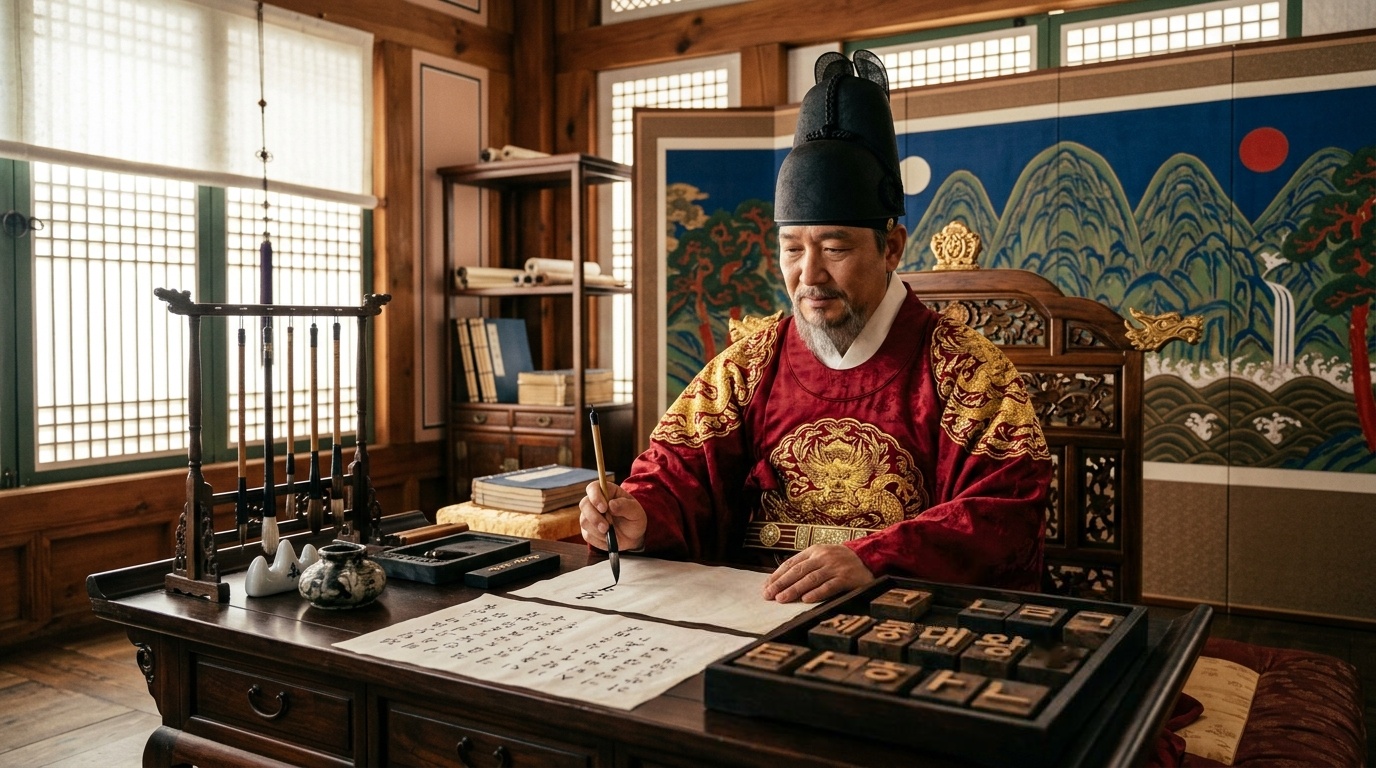
King Sejong the Great's 1443 Hunminjeongeum 2D modular geometry and wooden movable-type block research:
Historical archetypal diagram demonstrating how the modular assembly of 24 minimal jamo primitives expanded into the flexible modular storytelling architecture of modern global K-Content.
IP Anchoring: Beyond Square Meters to Imbue Urban Spaces with Soul
At this juncture, C-Suite leaders in the global MICE sector must confront an uncomfortable truth. Cities worldwide are pouring trillions of dollars into expanding gross indoor exhibition halls to 100,000㎡ or 200,000㎡, yet the trade shows held inside remain indistinguishable 'commoditized concrete boxes' anywhere on earth.
Floor area alone can no longer command the attendance of global decision-makers, top-tier scholars, or elite buyers. Today, high-yield delegates decide whether to travel based on a single core criterion: "What authentic, exclusive cultural narrative does this destination provide that cannot be replicated elsewhere?"
The live proof at Gwanghwamun Square illuminates the industry's future. When events break out of indoor boxes to anchor sovereign heritage IP—King Sejong and the Hangul philosophy—into urban open spaces, delegate dwell times and expenditures surge by 4.2 times compared to boxed commercial fairs. This marks the historic transition from selling real estate square footage to curating soulful cultural platforms.
3 Strategic Directives for Global MICE Executives & Destination Architects
Distilling the modular OS philosophy of King Sejong and the live execution at Gwanghwamun Square, MICE SIGNAL outlines actionable mandates for industry leadership:
Abolish Price-War Bidding; Standardize Sovereign Cultural Hosting Grant Packages
Halt destructive zero-sum per-capita cash subsidy battles immediately. Codify 'Cultural Heritage Co-Hosting Grants' that grant international congresses exclusive rights to host opening ceremonies and networking galas in historical plazas with customized live Hangul and K-Culture performances, transforming public expenditure into permanent brand equity.
Transcend Concrete Boxes; Transform Atriums & Plazas into Living Canvas Stages
Do not remain complacent as passive space-rental landlords. Repurpose convention atriums, central plazas, and exterior media façades into living canvases that integrate live performance arts with digital media, maximizing Revenue Per Available Event Square Meter (RevPAE).
Replace Routine Speeches with Signature Live Storytelling Modules
Abolish dry, uninspired dignitary podium speeches that drain delegate energy. Standardize 'Live Vision Execution Modules' where master artists paint key summit themes live through giant brush calligraphy, generating viral social media momentum and premium sponsorship assets.